

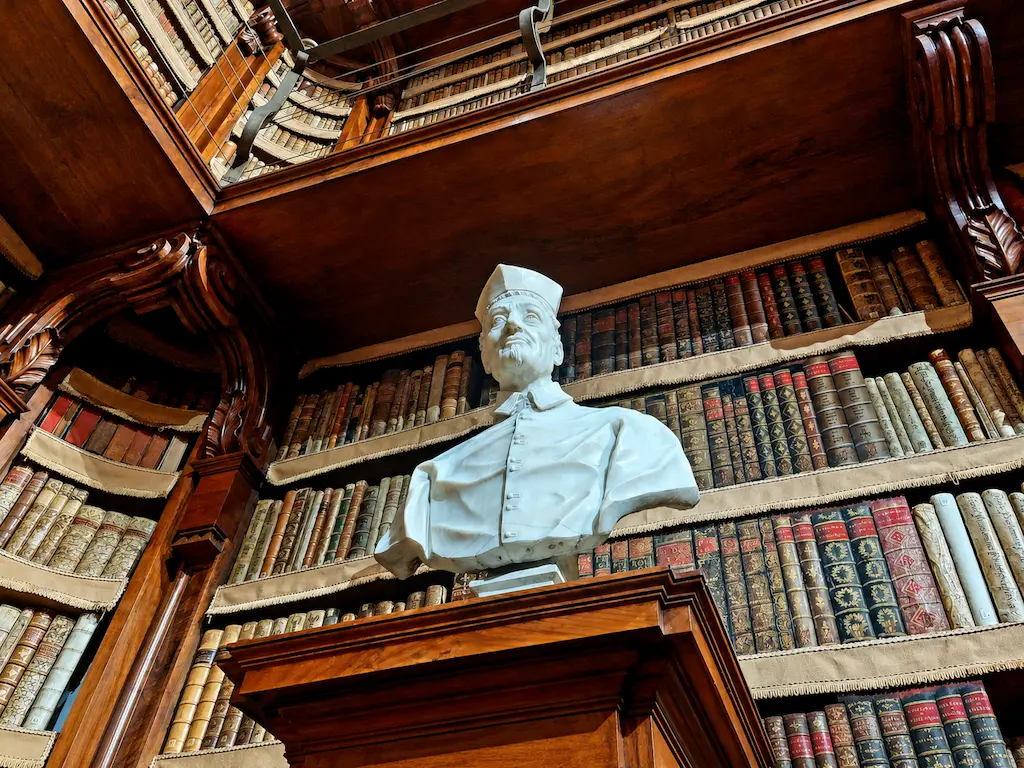


Since 1873, the librarians, who have succeeded one another in the direction of the Angelica Library, have taken care to increase its holdings by privileging those fields that have characterized it since its origins: Augustinian studies, Italian literature and literary criticism in the 15th-18th centuries, theater history, Reformation and Counter-Reformation, Romanesque, opera librettos and Bodonian editions.
In nearly a century and a half, the holdings have increased by about another 100,000 volumes of Italian and foreign editions and bibliographic aids in both print and electronic media.
Over the course of the last century, between 1944 and 1952, Francesco Barberi worked to acquire ten volumes of Luigi Zanazzo’s autographs, containing unpublished compositions and collections of proverbs from plays and Roman folk songs.
He also received a donation of documents related to the poetic and literary work of Domenico Gnoli (1838–1915) and the correspondence of the archaeologist Felice Barnabei (1842–1922).
In 1975, the Angelica Library received a bequest from literary critic Arnaldo Bocelli: a collection of 8,600 items, including books, essays, and journals on 20th-century Italian literature.
Also from the 20th century, the collections formerly owned by the Marcello Cardone family and that of Achille Tartaro are particularly noteworthy.