





The manuscript, compiled at the end of the 13th century, contains Pietro da Eboli’s poem, De Balneis Terrae Laboris, on the healing properties of the thermal waters in the area between Pozzuoli and Baia, better known under the title De balneis Puteolanis.
The poem was dedicated to and inspired by Frederick II of Swabia, sol mundi, who had the opportunity to experience the virtues of the baths at Pozzuoli for himself.
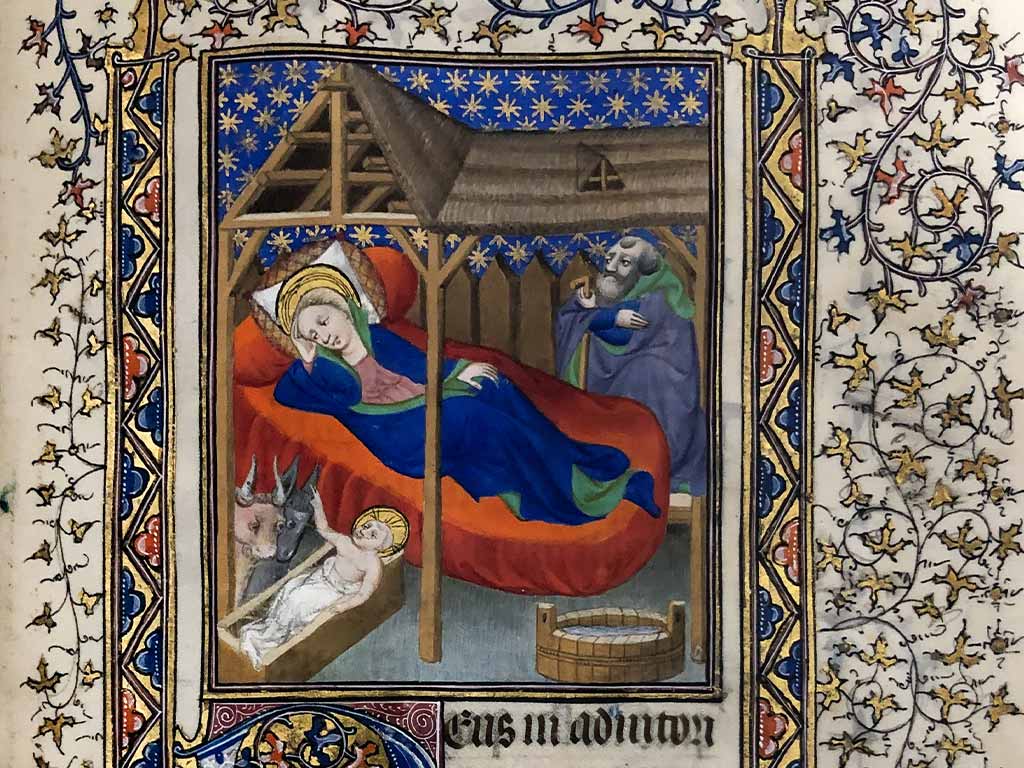
It is a manuscript richly illustrated with eighteen stunning full-page miniatures, which illustrate the text of the eighteen epigrams that make up the work – a text that is both a scientific treatise and a poetic composition.
The miniatures, the work of a single artist, are framed by a narrow border in blue, green or red, and are executed using the gold-leaf background technique. They constitute one of the most important examples of miniature painting from southern Italy, and perhaps from Sicily, in the 13th century: Byzantine elements are juxtaposed with realistic motifs, and Roman architecture with Eastern domes. The human figures share common facial features and are depicted with few variations; by contrast, the landscape references and settings are varied and imaginative.
Provenance: In the 18th century, the manuscript belonged to Mario Guidarelli, as evidenced by the note of ownership on folio 1r. It came into the Angelica Library via the library of Domenico Passionei. It is listed in the inventory of Cardinal Passionei’s library, Ms. Parmense 878, p. 453.
Bibliography:
Narducci, Catalogus codicum manuscriptorum praeter graecos et orientales in Bibliotheca Angelica olim Cenobi Sancti Augustini de Urbe, Romae, Typis Ludovici Cecchini, 1893, tomo I, p. 634.
Catalogue of the National Historical Exhibition of Miniatures, Palazzo Venezia – Rome, Florence, Sansoni, 1953, p. 263, no. 415.
Giacosa, Magistri Salernitani, pp.397-399; Atlante, tavv.28-33.
D'Ancona, I bagni di Pozzuoli raffigurati in un codice napoletano de' primi del secolo XIV, in L'Arte, XVI (1913), pp.464-470.
D'Ancona, La miniature italienne du X au XVI siécle, Paris 1925, p. 47, nt.4.
Joseph, I bagni di Pozzuoli descritti in due codici trecenteschi, in La Bibliofilia, XXXVIII (1936), pp.409-418 e fig. pp.411,415.
Lorenzetti, Le correnti pittoriche romana e senese e la tradizione locale in alcuni dipinti inediti della Campania, in Bollettino d'arte del Ministero della Pubblica Istruzione, XXX (1937), pp.419-421 e ff.3-4.
Volbach, Le miniature del codice Vatic. Pal,Lat. 1071 "de arte venandi cum avibus", in the Proceedings of Pontificia Accademia Romana di archeologia, XV (1939), pp.170-172.
Trésors des Bibliothèques d'Italie, IV-XVI siècle (Exposition à la Bibliothèque Nationale), Paris 1950, n.141.
Luciani A., La miniatura e la prossima esposizione d'arte antica in Roma, in La Nuova Antologia II, XXXVII, 1833, p.316.