





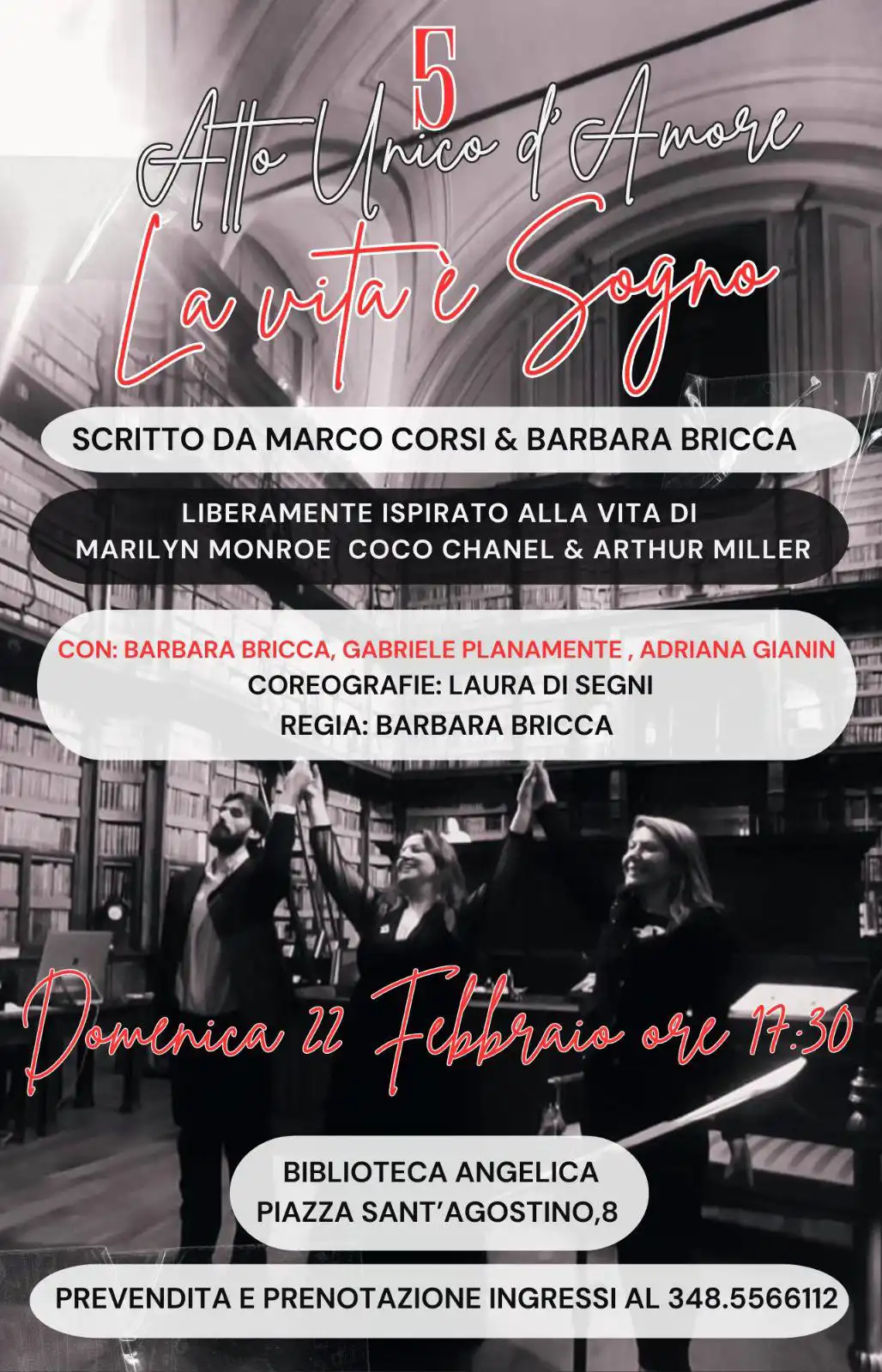
In “5”, a one-act play about love, the theatrical dimension comes across strongly, rendered sincere and satisfying in a succession of monologues and dialogues, music and lights that intertwine relentlessly amid the torments and sighs of the protagonists.
Two divas, people and “characters” meet the audience in an intense scent of aroma and passion.
However, amid the refined elegance of love, a precise “literary” and “poetic” style emerges almost naturally, restoring an intellectual and cultural dimension to the comedy and conveying the dramatic message to both the hearts and minds of the audience.
In this production, the characters deliberately “dream,” and so the dreamlike dialogue between Marilyn and Coco powerfully evokes references to the plays “Life Is a Dream” by Calderón de la Barca, through Pasolini’s ‘Calderón’ and “Rosaura’s Dream,” to arrive at “A Midsummer Night’s Dream” with its Shakespearean echoes, and finally to “What Are the Clouds?,” Pasolini’s poetic-cinematic work.
Above all, the ultimate question: What is reality? Is it a dream, fiction, truth, or reality itself? This is the question posed by Norma Jean, the passionate yet bewildered protagonist, to the “mystical” storyteller Coco Chanel: in this age of “multiplicity” and baroque intricacy, the answer to the “transcendent” lies in the sacredness of love.
To reach the “truth” and beauty, one must remain in the human dimension with an exalted gaze toward the Highest.
The authors we have “smoothed” like the sea does with rocks suggest emotional balance: we will find a little truth in deception or good in evil or, again, reality in fiction.
The important thing is to rediscover the balance between “appearing” and “being,” the strong emotional discomfort that permeates Norma’s character and that dances continuously in the hands of her beloved Arthur so that “love triumphs, true love, the kind that does not betray.”