




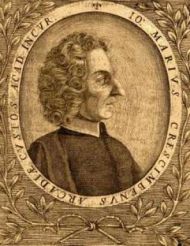
 Giovan Mario Crescimbeni was born in Macerata in 1663 into one of the most distinguished families in the Marche city. He received a particularly thorough education aimed at a career in law, to which, against his inclinations, his father had destined him.
In 1679, after receiving his law degree, he moved to Rome, where he actively participated in the intense cultural life. He thus became a member of the Accademia degli Umoristi, that of the Intrecciati and that of the Infecondi, to which he made his contribution as a proponent of classicism, and was, in 1690, with Gravina, Leonio, Zappi and Taia, among the fourteen intellectuals of the Christian circle who, in the memory of the former Queen of Sweden, founded the Arcadia. Appointed first general custodian, he soon imprinted the Academy with a direction of moderate classical and moralistic restoration, such that it could be accepted in every part of Italy and that, under the banner of the revaluation of national culture, did not let even the most blandly baroque component fall out of contemporary taste.
Crescimbeni's superficial classicist and moralistic restoration, which was practically exhausted in the bureaucratic organisation of the Academy and the regulation of a literary taste that was first a way of life, was supported by his diligent activity as a systematiser of the Italian literary tradition, in works such as The History of Vulgar Poetry and the Comentarj intorno alla storia della volgar poesia and in an unceasing laboriousness as a propagandist, publisher and historian of Arcadia, which since its fictionalised celebration of its glories, The ArcadiaIt increasingly came to coincide with its own fantasy world and its own legend, that is, in essence, the most effective instrument of Alfesibeo Cario's political-cultural project of literary unification and national hegemony (such was the name taken in Arcadia by Crescimbeni).
In 1705 he became canon and in 1719 archpriest of the basilica of S. Maria in Cosmedin, and published an interesting study on the history of Roman churches. He died in Rome on 8 March 1728, after having asked and obtained, to fulfil a vow, to enter the Society of Jesus.